







ADMISSIONS

NEWS & BLOG
CONTACT US
Learning Differences
Many students who attend Mansfield Hall arrive with a history of various labels, including learning differences, learning disabilities, challenges with working memory or processing speed, autism spectrum disorder (ASD), social communication disorder, a nonverbal learning disability (NLD/NVLD), or PDD-NOS, or even anxiety or depression. Often times, we are asked how we uniquely approach each of these diagnosis.
Although there are variations within each classification our response is that we work with People, not labels.
It should also be noted that with the publication of the DSM-V in 2013, as well as the DSM-V-TR (Text Revised) version released in 2022, Asperger’s is no longer recognized a formal diagnosis, and the traits previously associated with Asperger’s are now covered by the ASD-I criteria.
Regardless of important technicalities, it’s important to note that all of these diagnoses share commonalities that respond best to a holistic and integrated approach to addressing a student’s needs in college. Social challenges, difficulty with perspective-taking, and diverse learning needs require an approach that addresses much more than just academics, and thus our Four Core Approach evaluates and proactively addresses how these various characteristics can impact a student’s success.
When providing support and accommodations for students with and learning difference, including dyslexia, dysgraphia, ASD, PDD-NOS, & NLD or NVLDs it is critical to address these challenges across all domains. Unfortunately, there is no Autism College – and even the best colleges for students with Autism are not always able to comprehensively support all of the domains necessary for success. Colleges with autism support programs must not only address a student’s academic needs, but also their social engagement, independent living skills, and vocational skills. Asperger’s and college success can go hand in hand, as long as the impact of these characteristics on a student’s learning and living environment are carefully, intentionally, and explicitly addressed.




Succeeding in college with a learning differences, ASD, PDD-NOS, & NLD or NVLD can be challenging. Thus, Mansfield Hall’s comprehensive transition programs for students with autism and other related disabilities address the holistic needs for our students and individualizes student plans based on evidence-based practices. Mansfield Hall carefully evaluates and interprets information from assessments, interviews, and other helpful diagnostic tools to tailor the program to fit each student’s unique needs.
Please Note: With the publication of the DSM-V in 2013, as well as the DSM-V-TR (Text Revised) version released in 2022, Asperger’s is no longer recognized a formal diagnosis, and the traits previously associated with Asperger’s are now generally understood to be covered by the Autism/ASD-I criteria. While some members of our student community may still identify with Asperger’s Syndrome, Asperger’s, or Aspergers – or even as “Aspie” – we refer only Autism or ASD, as that is the current diagnostic neurodiverse nomenclature.
A Few Tips to Help Students Succeed in College with PDD-NOS , NLD, or NVLD
Succeeding in college with a diagnosis of PDD-NOS (Pervasive Developmental Disorder Not Otherwise Specified), NLD (Nonverbal Learning Disorder), or NVLD (Nonverbal Learning Disability) can be challenging, but it is possible with the right support and accommodations. Here are a few tips that may be helpful:
It’s important to remember that everyone with a learning difference – including neurodiversity, ASD, ADHD, PDD-NOS, NLD, or NVLD is different and that accommodations and strategies that work for one person may not work for another. It may take some time to figure out what works best for you, but with determination and support, you can succeed in college.
Good things take time- Eugene Halloween on Polaroids



Obsessed with a crafty queen! Aven and life skills coach Juneau working on her Halloween costume 🎃👻.
PS. Burlington students, be sure to check out sewing club!

Sometimes a 5K is called a fun run- can confirm that much fun was had by all! 🏃

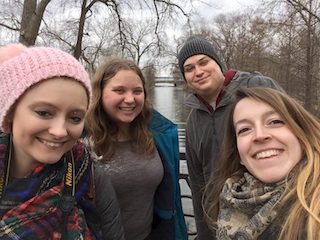
We`re doing our best to soak up these last fall days- it was well worth the effort this hike took!

There’s some fascinating research coming out surrounding the possible links between neurodivergence, hyper mobility, and regulation right now.
The overall conversation is surrounding the idea that neurodivergent folks are 4 times more likely to have generalized hypermoblity- a connective tissue disorder where the ligaments in the body are looser and thusly have to effort extra hard to hold everything in the body together. This additional effort the body has to exert daily to keep everything in order may be linked to a host of things, all pointing to the idea that these folks systems are working overtime to keep regulated.
Exercise, especially strength training can help ease this strain on the body by strengthening the muscles around the ligaments, which can help ease the job of those ligaments with consistent training over time.
Mansfield Hall offers students the opportunity to join in for two structured workouts a week focused on upper and lower body as well as core stability for this reason!
References
https://f.mtr.cool/1zp81xihlb
https://f.mtr.cool/0cuybkaq1y
https://f.mtr.cool/fcxsdbfwx4
https://f.mtr.cool/qxsnb8vtjx
https://f.mtr.cool/pridyliawk
